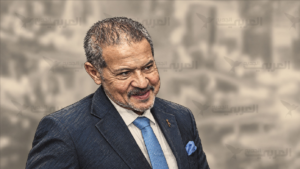

The official announcement by PA Chairman Mahmoud Abbas on October 26 regarding the temporary appointment of Hussein al-Sheikh as acting president , should the office become vacant , did not surprise anyone in the Palestinian arena.
At this stage, the Palestinian public has reacted with indifference due to the difficult economic situation and a lack of faith that any real improvement is expected soon for Palestinians in the West Bank and Gaza Strip.
Hussein al-Sheikh is far from popular among Palestinians; he is widely viewed as part of the corrupt circle Abbas has built around himself, and is rumored to have a history of womanizing and sexual harassment.
Senior PA officials say Abbas has paved the way for his deputy, Hussein al-Sheikh, to assume the presidency in the event of a vacancy, until general elections are held.
This step comes at a sensitive moment, intended to ensure a smooth transfer of power in the West Bank and prevent attempts to form alternative leadership structures outside the PLO framework.
PA officials described Abbas’s decision as a “necessary step” for several reasons: the complexity of the current stage, the need to prevent moves to bypass the PLO, and as part of reforms the PA committed to under international pressure.
On October 26, Abbas issued a new constitutional decree stipulating that if the presidency becomes vacant in the absence of a functioning legislative council, the deputy chairman of the PLO Executive Committee will assume the presidency for no more than 90 days, during which free and direct presidential elections must be held.
If elections cannot be held due to force majeure, the period may be extended by a single decision of the PLO Central Council.
Abbas justified his decision as driven by “awareness of this sensitive stage in the history of the Palestinian cause, and out of historical and constitutional responsibility to preserve the Palestinian political system and the security of the state and its institutions.” He added that the decree is meant “to guarantee the principle of peaceful transition of power through free and fair elections.”
The new decree cancels the previous one (No. 1 for 2024), which designated PLO National Council Chairman Rawhi Fattouh as acting president for 90 days.
What Is Really Behind Abbas’s Decision?
In the Palestinian arena, several explanations are circulating regarding the timing of Abbas’s move:
- Senior Fatah officials say the decision was made at the request of the United States and without Israeli objection.
According to them, President Trump fears that a sudden departure of Abbas due to his health could trigger political and security chaos in the Palestinian arena, making it difficult to implement his Middle East peace plan.
The decree does not appoint al-Sheikh as permanent president, but stabilizes the situation by establishing a temporary mechanism and an obligation to hold elections. - The move is also intended to further strengthen al-Sheikh’s standing and force Marwan Barghouti to acknowledge his leadership, in light of speculation that Barghouti may soon be released by Israel.
Surveys consistently show Barghouti as the most popular candidate among Palestinians in both the West Bank and Gaza Strip, and the frontrunner in any presidential election.
Abbas and al-Sheikh previously blocked his release in the 2011 “Shalit deal,” convincing the United States and Israel that Barghouti’s return could spark a new intifada and overturn the Oslo Accords.
There is deep rivalry between the Abbas-al-Sheikh camp and Barghouti, who has drawn closer to Hamas in recent years. Former Hamas political bureau chief Ismail Haniyeh, before being assassinated in Tehran, promised Barghouti’s wife that her husband would be released in future hostage-exchange deals. - Al-Sheikh is closely tied to Abbas’s two sons, who control a vast business empire, and is seen as someone who will protect their interests once Abbas leaves the stage.
The announcement comes amid American, Western, and Arab efforts to shape the “day after” in Gaza , a process the PA insists must remain fully under Palestinian control.
The PA opposes any administrative body in Gaza not subordinate to it, and rejects deployment of international forces without a UN Security Council mandate , and even then, only along the borders, insisting that security in Gaza must remain a Palestinian responsibility.
Hussein al-Sheikh was appointed deputy president in April, as part of a broad reshuffle of Palestinian political and security institutions.
His position is now expected to strengthen further, increasing his chances in future elections.
Senior PA officials view this decision as a clear sign the PA has no intention of relinquishing its role in Gaza and is responding to international demands for reform and greater legitimacy.
Al-Sheikh is considered the “chief architect of current Palestinian policy” and “a familiar figure to everyone, including the Americans.”
In recent years he has become Abbas’s closest adviser and leads contacts with Israel, the United States and Arab states. He is now among the most influential decision-makers in the PA.
The Egyptian Foreign Ministry announced that Minister Badr Abdel-Ati spoke by phone with al-Sheikh about efforts to advance Palestinian reconciliation and strengthen internal unity.
According to the statement, Egypt continues to support the PA and its efforts to rebuild Gaza.
The two also discussed preparations for the reconstruction and development conference for Gaza and the need to secure adequate international assistance for the Palestinian people.