The framework agreement between Israel and Lebanon is far more than a new security arrangement along the northern border.
Beneath the diplomatic process lies a much deeper struggle over Lebanon’s future, Hezbollah’s role, and the fundamental question of who will ultimately hold the state’s monopoly on the legitimate use of force.
Senior political and security officials assess that the further the agreement advances toward implementation, the greater the risk of internal conflict within Lebanon.
According to these officials, the controversy reached a critical point following the extraordinary warning issued by Lebanese Parliament Speaker Nabih Berri, who cautioned against a fitna ,an Arabic term referring to civil strife or civil war.
His statement underscored that the dispute over the agreement is no longer confined to border security or military arrangements, but has evolved into a direct challenge to Lebanon’s internal balance of power and Hezbollah’s future status.
The Shiite leadership’s primary concern, reflected both in Berri’s remarks and among his political allies, is that the agreement could become a mechanism for mounting domestic pressure aimed at the gradual disarmament of Hezbollah.
From this perspective, Israel is not seeking merely to consolidate its military gains.
Rather, it seeks to establish a new reality in which the Lebanese state, backed by the United States, assumes responsibility for neutralizing Hezbollah’s military capabilities.
This exposes Lebanon’s deepest structural dilemma: the tension between the concept of state sovereignty and the continued existence of an armed organization operating outside the state’s institutional framework while effectively defining the limits of that sovereignty.
Senior security officials argue that Hezbollah, which portrays itself as Lebanon’s defender against Israel, has increasingly become a force that undermines the Lebanese state’s ability to function as a genuinely sovereign authority.
The very existence of an independent military force aligned with the regional agenda of the so-called “Axis of Resistance” has created a dysfunctional dual system in Lebanon, one in which formal state institutions coexist with a parallel military and political power center.
Viewed through this lens, Hezbollah’s opposition to the framework agreement reflects more than security concerns.
It is also an effort to preserve an internal power structure that prevents the Lebanese state from freeing itself from external influence and from the fragmentation of security authority.
Speaker Nabih Berri himself has attempted to project a dual message.
On one hand, he strongly opposes an agreement he views as harmful to Lebanon’s interests and the regional balance of power.
On the other, he has repeatedly urged all parties to avoid sliding into internal confrontation.
Behind this cautious rhetoric, however, lies an implicit acknowledgment that the current reality, in which Hezbollah maintains an independent military force , has itself become a continuing source of instability.
The risk of civil war is therefore not merely a possible consequence of the agreement, but also a product of the political system that Hezbollah has helped shape over the past two decades.
According to senior security officials, Hezbollah’s central argument, that linking an Israeli withdrawal to its disarmament constitutes an assault on Lebanese sovereignty ,ignores a fundamental contradiction.
In practice, the existence of an autonomous armed force operating outside state control represents an ongoing erosion of that very sovereignty.
Rather than allowing the Lebanese state to establish an exclusive monopoly over the use of force, Hezbollah has created a reality in which strategic national decisions are frequently made outside official institutions, often in coordination with broader regional interests that do not necessarily coincide with Lebanon’s national priorities.
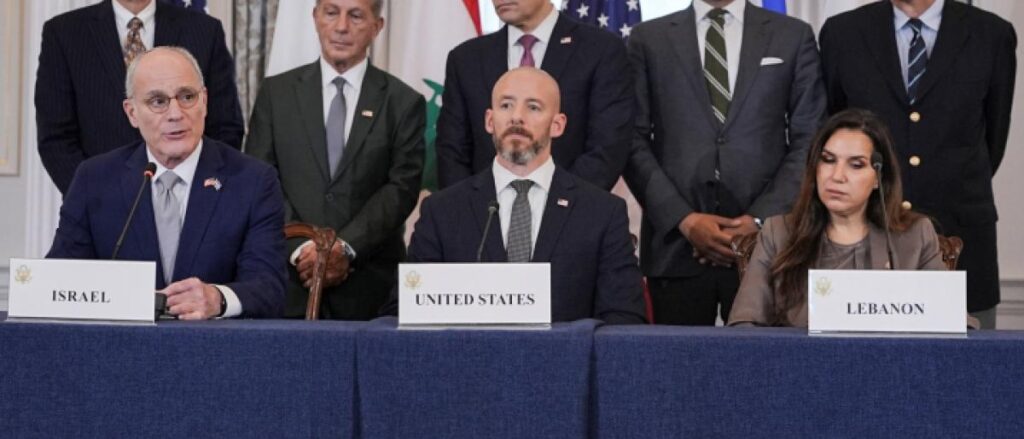
Against this backdrop, the agreement negotiated in Washington is not simply another security arrangement with Israel.
It represents an attempt to revisit Lebanon’s most fundamental question: Is Lebanon a fully sovereign state, or is it a political system in which parallel armed centers of power continue to restrict the government’s ability to make independent national decisions?
Hezbollah’s fierce opposition to the agreement, coupled with repeated warnings of internal unrest, reflects not only concern over its immediate consequences but also a profound recognition that successful implementation could significantly weaken the organization’s position as Lebanon’s dominant military force.
Ultimately, Berri’s warning against fitna should not be viewed merely as a warning about a future scenario.
It is also a reflection of Lebanon’s existing reality, where the question of Hezbollah’s weapons has long ceased to be solely a security issue. Instead, it has become the central debate over the identity, sovereignty, and future character of the Lebanese state.
Security officials believe that as implementation of the agreement progresses, the contradiction between the concept of a sovereign Lebanese state and the continued existence of an autonomous armed organization will become increasingly difficult to reconcile. In that sense, Lebanon is confronting far more than a diplomatic agreement with Israel.
It faces a historic internal decision: whether it can finally establish full state sovereignty or continue functioning as a fragmented political system in which state authority remains fundamentally constrained.
Senior security officials further assess that should Lebanon’s internal political crisis deteriorate over the dispute surrounding the agreement, Hezbollah could resort to one of two scenarios.
The first would involve the deployment of its military forces to seize control of Beirut, impose a siege on the Parliament building and the Prime Minister’s Office, and use force to intimidate state institutions.
The second, more extreme scenario would involve political assassinations targeting key figures associated with the negotiations with Israel, including Lebanon’s chief negotiator, Ambassador Simon Karam, Prime Minister Nawaf Salam, or President Joseph Aoun.
Such assessments are not without historical precedent. In 2005, Hezbollah was widely accused by its opponents of orchestrating the assassination of former Lebanese Prime Minister Rafik Hariri, in what critics argue was an effort to preserve both Hezbollah’s dominance and Syria’s influence over Lebanon.