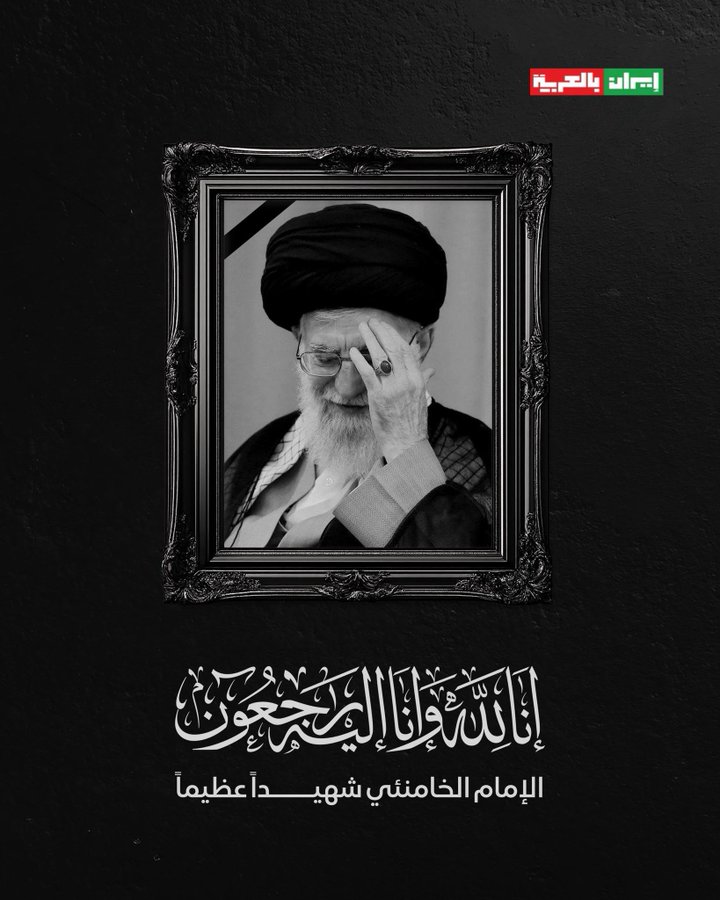
Senior security officials say the death of Iran’s Supreme Leader, Ali Khamenei, marks the end of an era that shaped the Islamic Republic for nearly half a century.
According to these officials, if Ayatollah Ruhollah Khomeini was the father of the Islamic Revolution and the founder of the regime, then Ali Khamenei was the architect who transformed that revolutionary vision into a comprehensive political, military, and regional strategy.
Ironically, the very system he built to ensure the regime’s survival ultimately led to the war that resulted in his own demise.
When Ali Khamenei was appointed Supreme Leader in 1989, following the funeral of Ruhollah Khomeini, Iran faced the immense challenge of rebuilding after its eight-year war with Iraq.
Over the course of his 37-year rule, Khamenei amassed unprecedented authority, becoming the most influential leader in the history of the Islamic Republic.
He shaped virtually every aspect of the Iranian state, from its security establishment and economy to its foreign policy and governing institutions.
Senior security officials argue that Khamenei’s most consequential strategic decision was transforming the concept of “exporting the Islamic Revolution” into an organized regional system of armed proxies, in effect, a vast network of terrorist organizations operating throughout the Middle East.
Under his leadership, Iran established what became known as the “Axis of Resistance,” a network that included Hezbollah in Lebanon, Shiite militias in Iraq, the Houthis in Yemen, and Palestinian terrorist organizations such as Hamas and Palestinian Islamic Jihad. These groups received Iranian funding, military training, weapons, intelligence support, and strategic direction.
From Tehran’s perspective, this network served as the Islamic Republic’s defensive shield against potential Israeli or Western strikes on its nuclear program. At the same time, it functioned as a strategic ring of encirclement around Israel through tens of thousands of missiles and drones assembled under the guidance of General Qassem Soleimani, commander of the Quds Force. In practice, however, the Axis of Resistance evolved into a permanent mechanism of confrontation against Israel, the United States, and their allies.
Alongside this regional strategy, Khamenei consistently advanced Iran’s nuclear and ballistic missile programs despite international sanctions and mounting diplomatic pressure, convinced that only overwhelming military strength and deterrence could guarantee the regime’s survival.
According to senior security officials, however, this very strategy became Iran’s greatest vulnerability.
As Tehran expanded its regional influence, the price it was forced to pay grew accordingly. Its reliance on armed terrorist proxies, coupled with the continued development of its nuclear and ballistic missile capabilities, transformed Iran into what these officials describe as a terrorist powerhouse threatening not only Israel but regional and international security, making it a primary strategic target for both Israel and the United States.
According to these assessments, the most recent war represented the culmination of this trajectory. For the first time, the military confrontation between Israel and the United States on one side and Iran on the other was carried directly into the heart of the Iranian establishment, striking its senior military and political leadership.
Throughout Khamenei’s rule, Iran also faced repeated waves of domestic unrest, beginning with the student demonstrations of 1999, continuing through the protests that followed the disputed 2009 presidential election, and culminating in the widespread nationwide protests of recent years.
The gap between the regime’s rigid theocratic dictatorship and growing segments of Iranian society widened steadily over time. The Islamic Revolutionary Guard Corps, which Khamenei elevated into the central pillar of his rule, played the decisive role in suppressing these protests and tightening the regime’s grip on power.
According to senior security officials, over the years the Revolutionary Guards evolved far beyond a conventional military force. They became an economic, political, and security powerhouse, controlling vast sectors of Iran’s economy, its defense industries, its ballistic missile program, and the activities of Iran’s regional proxy organizations.
As their influence expanded, Iran’s leadership became increasingly dependent upon them until they emerged as the single most powerful institution within the Islamic Republic.
The latest war underscored this transformation. The appointment of Mojtaba Khamenei as the new Supreme Leader, together with the prominent public appearance of Islamic Revolutionary Guard Corps commander Ahmad Vahidi during Ali Khamenei’s funeral ceremonies, while the new Supreme Leader himself remained largely absent from public view, reinforced security officials’ assessment that the Revolutionary Guards will continue to dominate Iran’s strategic decision-making even after Ali Khamenei’s passing.
Ali Khamenei’s legacy remains deeply contested.
His supporters will remember him as the leader who strengthened Iran’s independence, expanded its regional influence, and transformed it into a major Middle Eastern power.
His critics, by contrast, will remember him as a ruthless dictator who consistently prioritized military expansion and ideological ambition over the welfare of the Iranian people, whom he repressed through force, while leading his country into an enduring confrontation with both the West and Israel.
The historical irony is unmistakable. The military architecture Khamenei spent decades constructing to safeguard the regime ultimately became the principal driver of an unprecedented escalation with Israel and the United States.
The regional terrorist network he cultivated was intended to deter Iran’s enemies. Instead, it became one of the principal factors that brought the conflict directly onto Iranian soil and ultimately contributed to his own death.
“The man who sought to build a nuclear bomb capable of destroying the State of Israel ultimately brought about his own destruction,” a senior Israeli government official said.
According to the official, the massive funeral ceremonies symbolize far more than the passing of a single individual. They mark the end of the era that shaped the Islamic Republic since the late 1980s and usher in a new chapter in which Iran’s leadership must decide whether to continue along Ali Khamenei’s path or forge an entirely different strategy for confronting the profound domestic and regional challenges now facing the country.