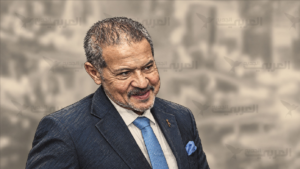

Senior PA officials say that Fatah leader Marwan Barghouti, who is serving five life sentences in an Israeli prison and is widely regarded as one of the architects of the Second Intifada, is planning to run in the Palestinian presidential election against the current PA chairman, Mahmoud Abbas (Abu Mazen). The election is expected to take place in the first quarter of next year.
Senior Fatah officials told me that Barghouti has formulated a new strategy for securing his release from an Israeli prison.
After being sidelined in the hostage deals negotiated between Israel and Hamas, in which he was not released because of strong Israeli opposition, Barghouti has now reached the conclusion that his only realistic path to freedom is to be elected president of the PA.
Barghouti’s plan, according to these officials, is to run for the presidency from inside the Israeli prison, win the election, and then exert massive international pressure on Israel to secure his release.
Barghouti believes that the upcoming Knesset elections could lead to a change of government in Israel, and that a new government might be more responsive to international pressure to release him.
He also believes that he could soon become part of an American and Arab effort to rebuild the Palestinian political system ahead of the “day after” in the Gaza Strip.
On the Palestinian street, Barghouti is widely regarded as a figure capable of uniting Palestinians in the West Bank and Gaza Strip around a political settlement based on the two-state solution.
Abbas Seeks to Block Barghouti
PA Chairman Mahmoud Abbas opposes Barghouti’s release from Israeli prison because of their political rivalry, according to senior Fatah officials.
Abbas intends to run for president himself, or alternatively, depending on his health, to support the candidacy of his son, Yasser, whom he has already succeeded in bringing into the leadership of the Fatah movement through the elections to Fatah’s Eighth General Conference last May.
Abbas is also seeking to prevent Barghouti from legally running for the PA presidency. He has amended the election law in a way that allows only the head of a political party to run for the presidency.
Barghouti is a senior Fatah leader and a member of the movement’s leadership, but he is not its head. Abbas is regarded as the head of the movement.
However, according to Fatah sources, senior Fatah official Qadura Fares, a close associate of Barghouti, has already prepared what is known as a “shelf party” , a political party that can be formally launched ahead of the presidential election, with Barghouti then assuming its leadership and running for president under its banner.
Strong Opposition to Legislative Elections on the Scheduled Date
According to senior Fatah officials with whom I spoke, most members of the Fatah leadership oppose Abbas’s decision to hold elections for the Palestinian Legislative Council on November 28. They recommend postponing the elections until sometime next year for several reasons:
First, the situation in the Gaza Strip does not currently allow for elections to be held.
Second, there is concern that Fatah could suffer an electoral defeat similar to what happened in the 2006 elections. Mohammed Dahlan has built a strong coalition with Hamas and Palestinian Islamic Jihad, and there is a possibility that this alliance could defeat Fatah.
Third, Israel opposes the participation of residents of East Jerusalem in the elections.
The leading figures opposing the holding of legislative elections at the end of November are Hussein al-Sheikh, deputy chairman of the Palestinian Authority, and Fatah Secretary-General Jibril Rajoub, who recently reconciled after a dispute that had lasted for many years.
They are demanding that the PA chairman wait for the final results of the Israeli elections, reassess the balance of power between Fatah and Hamas, and hold the legislative elections only next year.
The battle over Barghouti’s political future is therefore becoming part of a much broader struggle over the future leadership of the PA. For Abbas, the central challenge is preventing a popular rival from turning his imprisonment into a political asset. For Barghouti, the prison cell may become the very platform from which he seeks to return to the center of Palestinian politics , and potentially to the presidency itself.