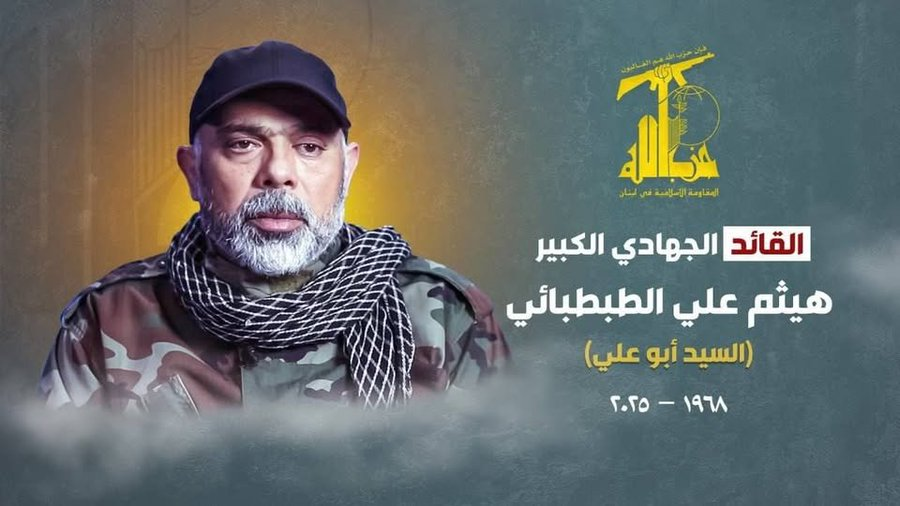
Following the failed assassination attempt against Hamas’ leadership in Doha, the capital of Qatar, Israel once again demonstrated its capabilities. On November 23 it eliminated Hezbollah’s Chief of Staff, Haitham Ali Tabatabai, in a safehouse located in the heart of Beirut’s Dahia neighborhood, Hezbollah’s stronghold.
This is a major operational and intelligence achievement. Since the ceasefire in Lebanon about a year ago, Hezbollah’s Chief of Staff was responsible for the organization’s intensive rehabilitation and the rebuilding of its military capabilities.
Senior security officials say the strike in the Dahia removed the implicit immunity that Beirut had previously enjoyed from Israeli attacks on Hezbollah assets.
Over the past year, Israel carried out only a handful of strikes against Hezbollah targets in Beirut, trying to avoid escalation and giving the Lebanese government time to dismantle Hezbollah’s arsenal on its own. The assassination operation sends a message to both the Lebanese government and Hezbollah: Beirut is now a legitimate target for Israeli military action.
Yet the main message Israel sought to convey with the timing of the assassination is that its patience has run out.
Israel is increasingly frustrated that the Lebanese government, despite deciding to disarm Hezbollah and receiving backing from Israel, the United States, and the international community, is dragging its feet, while Hezbollah rapidly rearms and strengthens itself with Iran’s support.
Hezbollah was completely caught off guard by the assassination and is now debating how to respond to what constitutes another operational and moral blow to the organization, indeed, a form of humiliation.
Senior security sources say Hezbollah is consulting with Iran, which will have the final say.
The killing of Hassan Nasrallah entirely stripped the organization of whatever limited independence it once had vis-à-vis Tehran.
Hezbollah’s reconstruction is now wholly dependent on Iranian weapons and funding.
In the past year, the organization has not only been amassing rockets, missiles, UAVs, and drones, but has also been rebuilding the Radwan Force, a unit intended to infiltrate Israeli territory, seize parts of the Galilee, and carry out massacres reminiscent of October 7.
Haitham Tabatabai, who previously commanded the Radwan Force, was appointed Chief of Staff in part to rebuild the unit and prepare it for the next round of fighting with Israel.
Tabatabai is the 175th senior Hezbollah commander killed by Israel since the war began more than two years ago.
Senior security officials estimate that his assassination will hinder Hezbollah’s recovery and military buildup , but will not stop a process directed from Tehran.
Hezbollah is expected to appoint a replacement shortly and continue its military expansion despite the blow.
According to senior defense assessments, Hezbollah will likely contain the incident for now and refrain from firing into Israel’s home front.
The organization fears falling into an Israeli trap: any rocket or UAV attack could trigger a wide-scale Israeli air campaign that would destroy Hezbollah’s secret weapons stockpiles in the Dahia and Lebanon’s Bekaa Valley.
Senior political officials say Israel assumed immediate and unambiguous responsibility for the assassination, without hesitation or excuses, in order to send a clear message to the Lebanese government and Hezbollah: Israel is determined to disarm Hezbollah and fully capable of inflicting devastating military blows on the organization. It is not afraid of renewed war along the northern front.
This message is also directed at Iran, Turkey, Qatar, and Syria.
Through this strike, Israel has demonstrated that despite the Middle East peace plan promoted by Donald Trump, its hands are not tied. Israel maintains full freedom of military action and is preparing to prevent new scenarios reminiscent of the October 7 massacre.